


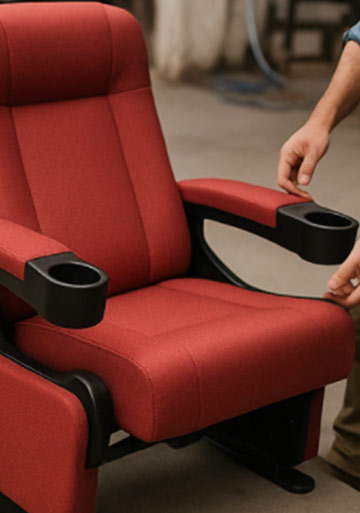
Lecture Hall Seating PM-415
Product Specifications
- Strong Cold-Rolled Steel Legs
Legs made from 80×35×1.5 mm cold-rolled steel tube provide excellent structural strength and long-term stability, especially suitable for high-usage educational environments. - Fireproof Laminated Backrest
Multi-layer board hot-pressed in a single mold and finished with eco-friendly fireproof laminate for enhanced rigidity, safety, and durability. - Durable Laminated Wooden Seat
Premium rotary-cut multi-layer wood veneer, hot-pressed with a fireproof laminate.
Seat dimensions: 45 × 38.5 × 16 mm, engineered for strength, comfort, and reliable performance. - High-Strength Steel Book Rack
Fabricated from 6 mm solid cold-drawn steel, offering long-lasting load capacity and anti-deformation performance. - Fixed Writing Board
Simple, stable fixed-type writing board design suitable for lecture halls and training spaces requiring durability and ease of use. - Maintenance-Free Gravity Return Mechanism
Smooth, quiet gravity-based seat return system that requires no additional maintenance, ideal for continuous daily operation. - Ideal for Modern Educational Facilities
Perfect for universities, colleges, auditoriums, training centers, and any venue requiring reliable fixed seating solutions.
Recommended Application
- Lecture Halls & Universitie
- Classrooms & Schools
- Training Centers
- Examination Halls
- Auditoriums with Study Function
- Government & Institutional Projects
- High-Density Seating Areas
Lecture Hall Seating FAQ
What is lecture hall seating?
Lecture hall seating refers to fixed classroom seating systems designed for:
· Universities
· Colleges
· Training centers
· Educational institutions
· Seminar halls
· Academic auditoriums
These systems usually include integrated desks and chairs.
What is the difference between lecture hall seating and auditorium seating?
Main differences:
Lecture Hall Seating | Auditorium Seating |
Includes writing tablets or desks | Usually no desk, but tablet |
Education-focused | Event-focused |
Higher desk functionality | Higher comfort focus |
Often used daily | Used during events |
What materials are used in lecture hall desks and chairs?
Common materials:
· Steel frame
· Aluminum frame
· MDF board
· HPL board
· Plywood
· PP plastic
· Molded foam
· Fabric upholstery
What is HPL board in lecture hall furniture?
HPL means High-Pressure Laminate.
Advantages:
· Scratch resistant
· Heat resistant
· Moisture resistant
· Easy to clean
· Durable for school environments
HPL is commonly used for desktops.
What is the standard row spacing for lecture hall seating?
Typical row spacing:
· 850–1000 mm
Spacing depends on:
· Tablet size
· Seat folding mechanism
· User comfort
· Walking space
Are lecture hall chairs suitable for heavy daily use?
Yes.
Commercial lecture hall seating is designed for:
· High-frequency classroom use
· Universities
· Public schools
· Technical institutes
· Training centers
Frames are reinforced for long-term durability.
Can lecture hall seating include power outlets?
Yes.
Optional features include:
· USB charging ports
· Power outlets
· Laptop charging systems
· Multimedia integration
· Microphone systems
What desk materials are best for universities?
Recommended materials:
· HPL board
· Compact laminate board
· Plywood with laminate finish
These materials provide:
· Better durability
· Easy maintenance
· Scratch resistance
· Longer service life
Can lecture hall seating be installed on stepped floors?
Yes.
It is commonly installed on:
· Concrete steps
· Tiered classroom floors
· Sloped educational halls
· Steel platforms
What are the advantages of fixed lecture hall seating?
Advantages include:
· Better space efficiency
· Organized classroom layout
· Improved visibility
· Cleaner appearance
· Easier maintenance
· Long-term durability


 Copy product links
 Long by picture save/share
INQUIRY


Add Successfully
INQUIRY
Add Successfully
Thank you for your interest in Foshan Promix Furniture Co., Ltd.
Please feel free to reach out to us for any inquiries, quotes, or collaboration opportunities.
Our team will respond to your message within 24 hours.
 Telephone: +86 17769664260
 Email: annypmfurniture@gmail.com
 No.628,Xingtan ShuixiangAvenue,Shunde District, Foshan City,Guangdong Province, China
Products
——
Office Chairs
Waiting Benches
Our work
——





点击右上角
分享给朋友吧
Sitemap | Copyright & MySite Ltd. copy; 2016. all rights reserved.
